
Breaking Free from Negative Thinking: 8 Common Thought Patterns and How to Change Them
- Livia Barbuti

- May 21
- 6 min read
Updated: May 22
Learn how automatic thoughts shape emotions and behaviour and discover practical ways to challenge eight common cognitive distortions.
Breaking Free from Negative Thinking: 8 Common Thought Patterns and How to Chang
Breaking Free from Negative Thinking: 8 Common Thought Patterns and How to Chang Negative thinking can trap us in patterns that limit our potential and distort how we see ourselves, other people and the world around us. Recognizing these patterns is the first step toward responding with greater clarity, flexibility and self-awareness.

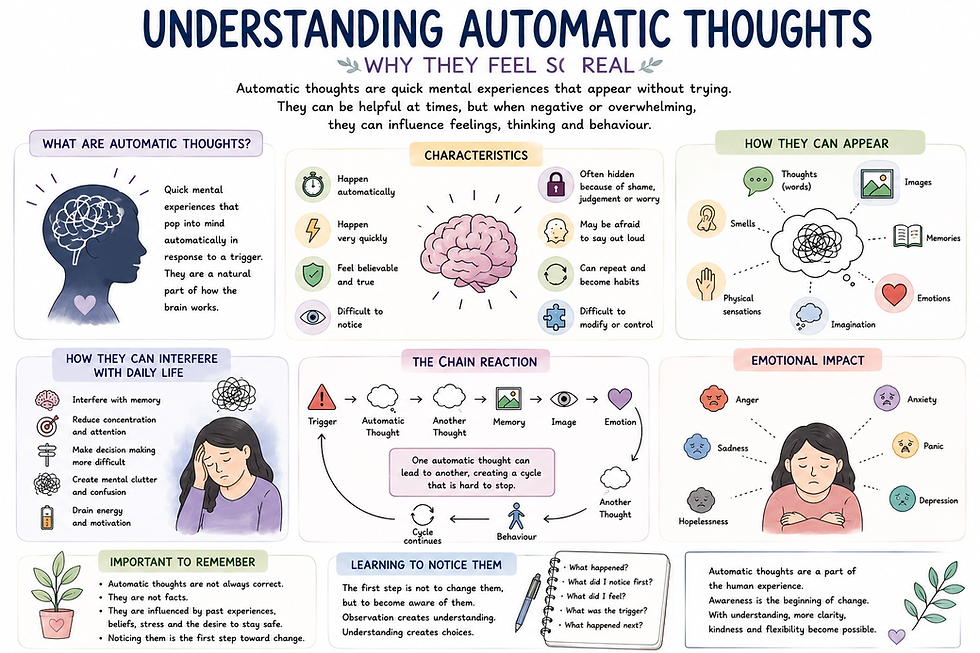
Before looking at the patterns themselves, it helps to understand that negative thinking is often driven by automatic thoughts. These are the quick interpretations that arise in response to everyday situations. A delayed reply, a difficult conversation, or a small mistake can trigger thoughts that shape how we feel and how we respond. When these thoughts go unexamined, they can reinforce the same emotional loop again and again.
Many of these automatic thoughts are learned over time. They may be influenced by past experiences, stress, criticism, family messages, or repeated beliefs about our worth and safety. Because they become familiar, they can feel convincing.
The good news is that once we start noticing these patterns, we can begin to question them and respond in more grounded ways.
Understanding Automatic Thoughts and the Thought-Feeling-Behaviour Loop
Automatic thoughts are the quick interpretations that arise in response to everyday situations. They can appear so fast that we barely notice them, yet they strongly influence our emotions and actions. For example, if someone does not reply to a message right away, the automatic thought might be “They are upset with me.” That thought may trigger anxiety, which then shapes how we respond.
This creates a loop: a situation leads to an automatic thought, the thought creates a feeling, and the feeling influences behaviour. Over time, these reactions can reinforce the original belief and make the pattern feel automatic. Many of these thoughts are learned through past experiences, stress, criticism, family messages, or repeated beliefs about ourselves. When we begin to notice the loop, we create an opportunity to pause, question the thought and choose a more balanced response.
The loop often looks like this:
Situation
↓
Automatic Thought
↓
Feeling
↓
Behaviour
↓
Reinforced Belief / Repeating Pattern
Example: A friend does not reply to a message right away. The automatic thought might be, “They must be upset with me.” That thought can trigger anxiety, which may lead to overthinking, withdrawing or sending extra messages for reassurance. In turn, that response can reinforce the belief that relationships are fragile or that something is wrong.
1. Filtering: Focusing Only on the Negative
Filtering happens when you focus only on the negative parts of a situation while ignoring anything positive or neutral. For example, after receiving feedback on a project, you might obsess over one small criticism and dismiss the praise. This narrow focus creates a distorted picture and can make setbacks feel bigger than they really are.
How to challenge filtering
· Write down both the positive and negative parts of the situation.
· Practice gratitude by naming what went well.
· Remind yourself that few situations are entirely bad or entirely good.
2. Polarized Thinking: Seeing Things as All Good or All Bad
Polarized thinking divides experiences into extremes. You might tell yourself, “If I’m not perfect, I’m a failure,” or “This is either a total success or a complete disaster.” This pattern leaves no room for mistakes, progress or complexity, which can increase pressure and self-criticism.
How to challenge polarized thinking
· Look for the middle ground instead of extremes.
· Remind yourself that most experiences exist on a spectrum.
· Use softer language such as “sometimes” “often” or “in some ways.”
3. Magnifying: Exaggerating Problems
Magnifying means blowing problems out of proportion and treating them as overwhelming or catastrophic. A small mistake can start to feel like proof that everything is going wrong. This pattern often fuels anxiety and makes it harder to think clearly or take constructive action.
How to challenge magnifying
· Ask yourself how likely the worst-case scenario really is.
· Break the problem into smaller, manageable parts.
· Focus on facts rather than fear-driven predictions.
4. Personalization: Taking Things Too Personally
Personalization happens when you assume that other people’s behaviour is about you, even when there is little evidence for that conclusion. If someone seems upset, you may immediately believe you caused it. This pattern can also show up through constant comparison, where your value is measured against someone else’s.
How to challenge personalization
· Consider other possible explanations for the other person’s behaviour.
· Shift your focus from comparison to your own growth and values.
· Practice self-compassion when you feel the urge to blame yourself.
5. “Should” Statements: Holding Rigid Rules About Behaviour
“Should” statements create harsh internal rules about how you and other people must behave. Thoughts such as “I should never make mistakes” or “People should always be fair” can lead to guilt, frustration, and disappointment. Rigid expectations often leave very little room for humanity or flexibility.
How to challenge “should” statements
· Replace “should” with “could” “would like” or “prefer.”
· Notice where your standards are becoming unrealistic or punishing.
· Allow room for imperfection in yourself and others.
6. Overgeneralization: Drawing Broad Conclusions from One Event
Overgeneralization means taking one difficult experience and treating it as a pattern that defines everything. After one failure, you might think “I always mess up” or “Nothing ever works out for me.” This pattern stretches one moment into a sweeping negative conclusion.
How to challenge overgeneralization
· Look for exceptions that do not fit the negative belief.
· Remind yourself that one event does not define your whole story.
· Avoid absolute words such as “always” and “never.”
7. Mind Reading: Assuming You Know What Others Think
Mind reading involves believing you already know what someone else thinks or feels, especially when it concerns you. For example, you might assume, “They think I’m incompetent” without any direct evidence. This pattern can fuel insecurity, misunderstandings and social anxiety.
How to challenge mind reading
· Ask for clarification instead of filling in the blanks.
· Remind yourself that assumptions are not facts.
· Focus on what is observable rather than what you imagine.
8. Catastrophizing: Expecting Disaster
Catastrophizing means automatically imagining the worst possible outcome and treating it as likely or inevitable. A problem becomes the beginning of a disaster story, filled with “what if” questions and escalating fear. This can leave you feeling overwhelmed before anything has actually happened.
How to challenge catastrophizing
· Separate the actual problem from imagined future disasters.
· Use grounding strategies to bring yourself back to the present moment.
· Make a realistic plan for what you would do if the problem continued.

How to Start Changing These Patterns
Recognizing a thinking pattern is not about criticizing yourself for having it. It is about increasing awareness so you can respond differently.
One helpful practice is to pause during emotionally charged moments and ask, “What just went through my mind?” Writing down the situation, the automatic thought, the feeling it triggered and a more balanced response can help interrupt the cycle and build a more flexible way of thinking over time.
Changing negative thinking patterns takes practice, but small moments of awareness can create meaningful change. The goal is not to think positively all the time or ignore real challenges. It is to notice when your mind is slipping into a distorted pattern, pause long enough to question it and choose a response that is more balanced, compassionate and grounded in reality.
Over time, those small shifts can strengthen a healthier inner voice and change the way you relate to yourself and the world around you.
If you would like to continue this work, you may download the chart below and use it to record your own situations, automatic thoughts, emotional responses and alternative perspectives.
If you would like additional support while working through these reflections, you are welcome to complete the worksheet below and reach out through the contact page.


Comments