
Anxiety Disorders Types, Symptoms & Coping Strategies

Anxiety Disorders Types, Symptoms & Coping Strategies
Anxiety Disorders Types, Symptoms & Coping Strategies Anxiety can feel like a false alarm in the body—your heart races, your thoughts speed up and everything feels urgent even when you are not in immediate danger.
Anxiety disorders can appear in different ways, but they often involve intense fear, worry, physical symptoms and avoidance. This blog explains panic attacks, agoraphobia, obsessive-compulsive disorder, post-traumatic stress disorder and generalized anxiety disorder. It also describes common symptoms, how anxiety can interfere with daily life and coping strategies that may help reduce anxiety responses.
Anxiety disorders can affect thoughts, emotions, physical sensations and behaviour. Common anxiety-related conditions include panic attacks, agoraphobia, obsessive-compulsive disorder, post-traumatic stress disorder and generalized anxiety disorder.
To understand anxiety disorders more clearly, it helps to begin with panic attacks, because panic shows how strongly anxiety can affect both the mind and body.
Understanding panic attacks
A panic attack is a sudden, intense and temporary episode of fear that can cause strong physical reactions even when there is no immediate danger.
It often focuses on what is happening inside the body, such as frightening physical sensations, fear of losing control, or fear that the symptoms mean something dangerous is happening.
Duration: Panic attacks often last a few minutes, but they can range from 5 to 20 minutes. Symptoms usually peak within about 10 minutes.
Panic attacks can affect thoughts, emotions and the body at the same time. Separating emotional symptoms from physical symptoms helps show how panic can feel overwhelming even when the person is not in real danger.

Emotional impact
· Fear or terror
· Fearfulness
· Anticipation of doom
· Losing control of yourself
· Fear of dying
· Fear of going insane
· Derealization
· Depersonalization
· Feeling detached from reality
Physical impact
· Shortness of breath
· Heart palpitations
· Sweating
· Sensation of having a heart attack
· Chest pain
· Nausea
· Trembling and shaking
· Chills
· Tingling
· Numbness
· Lightheadedness
How panic attacks can interfere with daily activity
· Withdraw from activities and people
· Stop taking care of self-care needs, such as avoiding a shower because of fear of having another panic attack or falling.
· Reduced ability to focus
· Avoid activities, social situations, or places associated with panic.
· Anticipate the next panic attack
· Monitor themselves for signs of another panic attack, which can lead to living in constant fear of panic returning.
· Feeling trapped with no way to escape
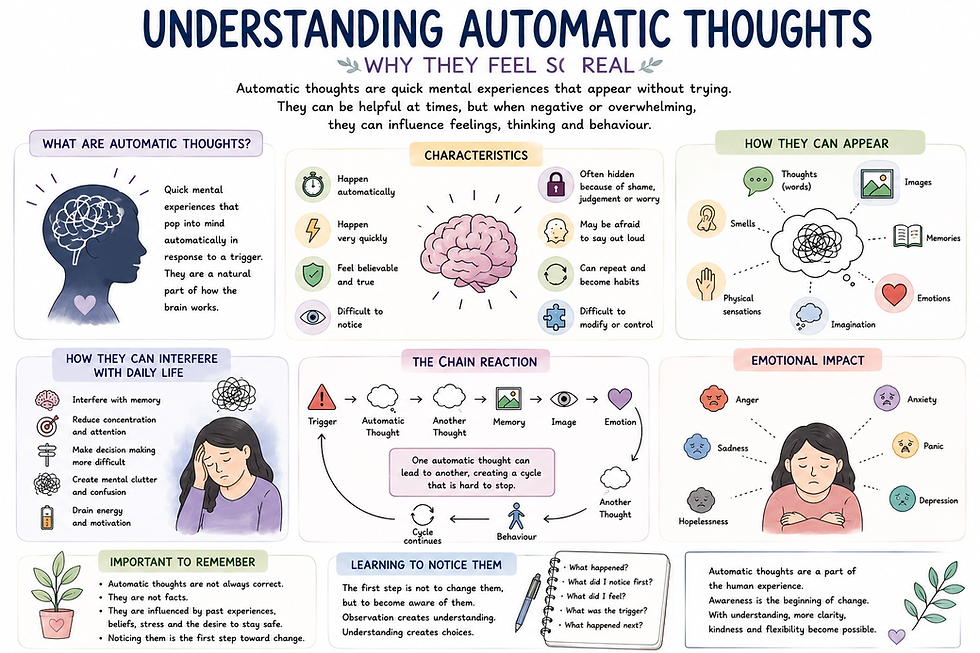
Panic often begins with an internal or external trigger. The person may start to worry, notice physical symptoms such as fight-or-flight sensations or hyperventilation, and then interpret those symptoms catastrophically. These catastrophic thoughts increase fear and can intensify the panic cycle.
Example: On a plane, a person may think, “I hope the plane doesn’t fall.” They may then feel trapped, panic, and experience fight-or-flight symptoms.
Catastrophic thoughts may include: “I’ll stop breathing” or “I’m going to have a heart attack.”
As the symptoms feel more intense, the person may think, “I’m going to die.”
Panic becomes harder to manage when frightening thoughts make the symptoms feel more dangerous than they are. Learning to notice and question these thoughts can help weaken the cycle.
Breaking the panic cycle by modifying thoughts
Catastrophic thought example:
“I will fall if I stand up” — Keep your head up, keep walking, and notice the objects around you. Losing balance during panic is rare.
“I’m too weak to walk” — My legs are strong enough to carry my body.
“Here comes the panic” — These symptoms are uncomfortable, but they are temporary and not dangerous. My body is sounding a false alarm.
During a panic attack, helpful steps may include slowing the breath, naming objects in the room, reminding oneself that the symptoms are temporary, relaxing tense muscles, and staying in the situation long enough for the anxiety to decrease. These steps can help reduce fear of the symptoms and weaken the panic cycle over time.
After understanding the panic cycle, the next step is learning practical strategies that can help calm the body, shift attention, and reduce avoidance.

What might help
· Practice mindfulness and breathing techniques, such as box breathing, diaphragmatic breathing, alternate-nostril breathing and the 5-4-3-2-1 grounding technique.
· Muscle relaxation
· Use “wise mind” observing notice thoughts and feelings without immediately reacting to them.
· Use diffusion: observe a thought as just a thought, rather than treating it as a fact or command.
· Practice letting go: imagine autumn leaves falling from a tree and floating away, while the tree remains steady and changes with each season.
· Get moving through small, manageable activities.
· Identify personal values and commit to them to improve motivation to overcome avoidance.
· Visualize accomplishments and imagine completing small goals successfully.
· Choose one fear to work on and use exposure to reduce the fear gradually. Start with an image or an imagined situation, then move to brief real-life exposure. For example, if you fear a place, first look at a picture of it, then imagine approaching it and noticing what happens, and finally visit the place for a few seconds before slowly increasing the time.
· Keep track of activities and progress.
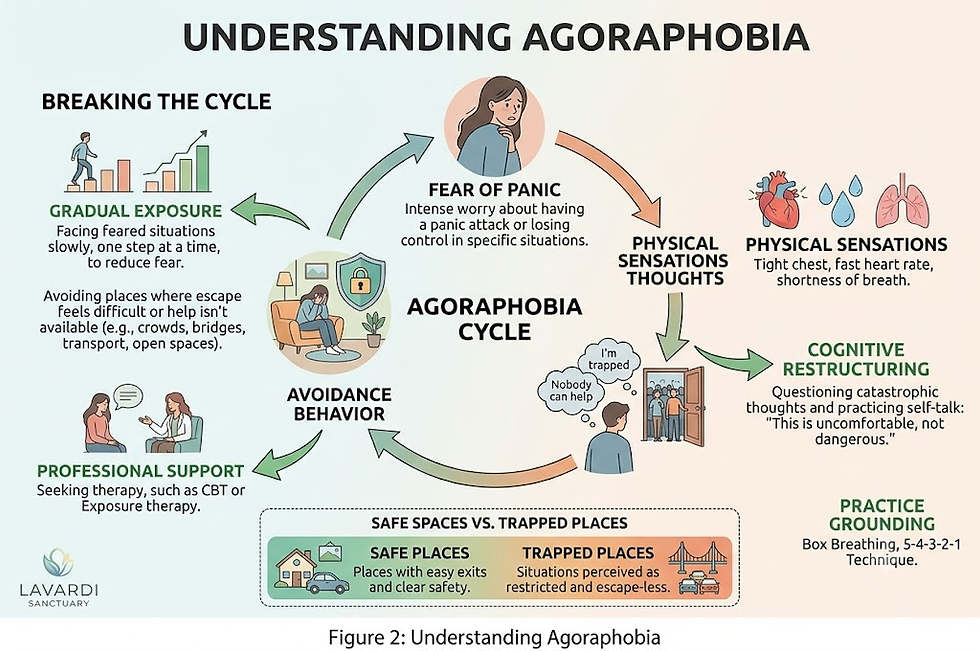
Panic attacks can also lead people to avoid places or situations where they fear panic might happen again. This avoidance can develop into agoraphobia.

Agoraphobia
Agoraphobia is an anxiety disorder related to fear of being in places where escape may feel difficult or help may not feel available if panic symptoms occur. A person may feel safer at home, at work, or in a car and may become anxious in places such as a dark cinema, a crowded room, or an unfamiliar environment. They may scan for exits, carry medication for reassurance, or avoid places that feel restricted. Over time, this search for safety can make anxiety stronger and limit daily activities.
While panic and agoraphobia often focus on body sensations and escape, other anxiety-related disorders involve different patterns of fear, thoughts and behaviours.
Obsessive-compulsive disorder
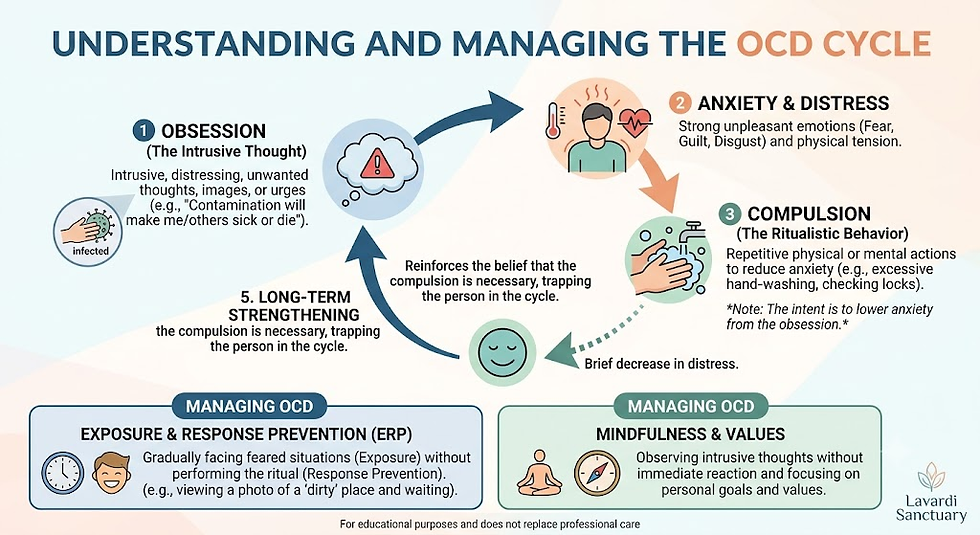
In OCD, obsessions are unwanted thoughts, images, or urges that create anxiety.
OCD involves unwanted thoughts that can feel irrational or unlikely but still create strong anxiety. For example, a person may fear that if they do not wash their hands, germs will make them sick or cause them to die. This fear can lead to physical anxiety symptoms such as a pounding heart, shortness of breath, muscle tension, neck or back pain and nausea.
The compulsive behavior of washing hands may reduce anxiety associated with the obsessive behavior of getting germs and die but each time engaging to reduce the obsession the link between them is becoming stronger even though the intent is to decrease the obsession of getting germs and get sick.
Some anxiety-related disorders are connected to specific experiences. PTSD is different from general worry because it develops after exposure to a traumatic event and can involve re-experiencing the event through memories, body sensations, or reactions to reminders.
Post-traumatic stress disorder
PTSD can develop after experiencing a life-threatening event or witnessing a loved one’s life being threatened. Examples may include a car accident, war, assault, robbery, threats of being killed, witnessing abuse, being abused mentally or physically, or having intruders in the home. After the traumatic event, the person may feel as if the experience is happening again, almost like being forced to watch a frightening movie repeatedly. Reminders of the event, such as smells, sounds, sights, clothing, objects, people, colors, or places, can bring back the feelings connected to the original experience. A person with PTSD may feel haunted by fear and may try to avoid reminders, triggers, and anxiety responses connected to the trauma.
Not all anxiety is connected to one specific event or trigger. For some people, worry becomes more constant and spreads across many areas of life.

Generalized anxiety disorder
Generalized anxiety disorder is a longer-term pattern of anxiety that is not always connected to one specific event. It often involves ongoing worry and negative expectations about the future. Symptoms may include muscle tension, changes in body temperature, intestinal or stomach discomfort, rapid heartbeat, restlessness, and hyperactivity.
Anxiety can feel powerful, but understanding how it affects thoughts, emotions, the body, and behaviour can make it easier to respond with awareness instead of fear. Learning about anxiety disorders and practising small coping steps can help people feel more grounded, reduce avoidance, and know when to reach out for support.
This information is for educational purposes and does not replace professional mental health care. People who experience severe anxiety, repeated panic attacks, trauma symptoms, or thoughts of harming themselves should seek support from a qualified health professional or emergency service.

Explore Related Resources

Comments