

Understanding Anxiety: What Happens in the Brain and How Breathing Can Help

Updated: Jun 6
Understanding Anxiety: What Happens in the Brain and How Breathing Can Help

If anxiety has ever made your heart race, your thoughts spiral, or your body feel like it is on high alert, you are not alone. These experiences can be frightening, but they make more sense when one understands what the brain and nervous system are trying to do. This article explains why anxiety can feel so intense and offers simple breathing tools that can help respond more calmly.
Anxiety is often described as worry, but it is really a whole-body stress response. It involves the brain, nervous system, and survival physiology. This response may be shaped by trauma, prolonged stress, or major life transitions.
When the brain detects possible danger, it shifts into protective mode. This response is designed to keep individuals safe, but it can also become overactive. This makes everyday situations feel harder to manage. Learning how anxiety works—and using practical tools such as trigger tracking and breathing techniques—can help create more steadiness, clarity, and control.
Why Anxiety Can Feel So Intense
Anxiety feels intense because it affects both the mind and body simultaneously. When the brain interprets a situation as threatening, it activates the body’s alarm system. In true danger, that response is protective. However, when it is triggered too easily or stays active too long, it can affect sleep, concentration, relationships, and everyday functioning. Recognizing this brain-body connection is a helpful first step.
Anxiety and panic are closely related, but they are not the same experience.
Anxiety — a diffuse, ongoing feeling of worry or dread that can come and go over hours, days, or longer.
Panic attack — a sudden, intense episode of fear or discomfort that usually peaks within 3–5 minutes and then passes.
Breathing strategies help because they address the physical side of anxiety directly. During a panic episode, they can reduce distress in the moment. With regular practice, they can also build resilience over time.
To understand why these tools work, it helps to look at the systems involved.
Core Systems Involved
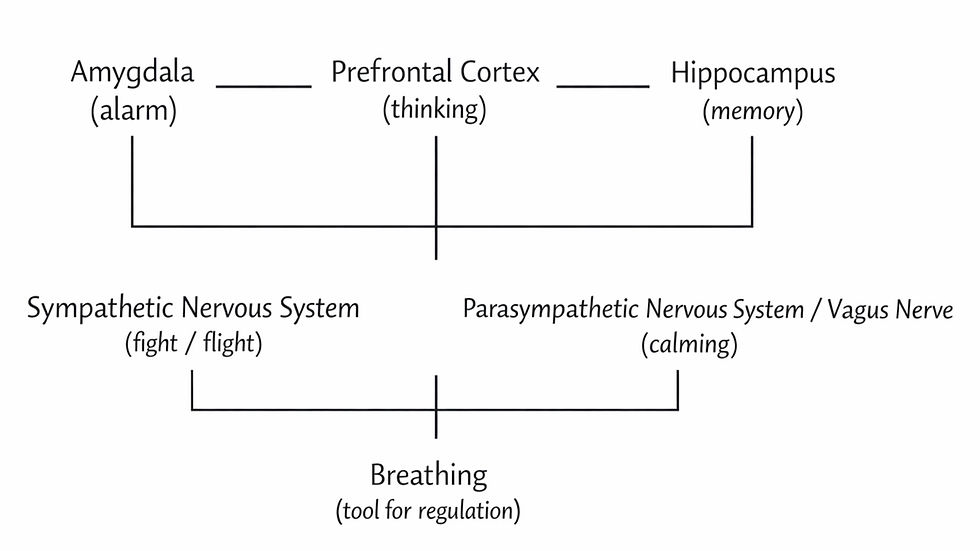
Amygdala — the brain’s alarm system; detects threat and triggers the body’s stress response.
Prefrontal cortex — the “thinking brain”; helps reason, plan, and regulate emotion (this quiets down during high anxiety).
Hippocampus — memory center; links past experiences to current situations (so memories can trigger anxiety).
Vagus nerve & autonomic nervous system (ANS) — carry signals between brain and body. The ANS has two branches:
- Sympathetic (fight/flight) — speeds things up.
- Parasympathetic (rest/digest, via the vagus nerve) — calms things down.
During panic, the amygdala signals danger. The nervous system speeds up, breathing often becomes shallow, and clear thinking becomes harder. This can create a powerful sense of urgency and loss of control.
Slowing and deepening the breath is one of the simplest ways to engage the body’s calming response.
Why Breathing Can Make Such a Difference
Fast, shallow breathing (hyperventilation) reduces carbon dioxide (CO₂) in the blood. Low CO₂ can cause dizziness, tingling in the face and fingers, and worsening panic.
Slow, diaphragmatic breathing restores the balance of oxygen/CO₂, stimulates the vagus nerve, and signals safety to the brain.
Focusing on the belly (diaphragm) also gives attention a concrete task. This distracts the mind from fearful loops and brings calm.
Two Breathing Techniques to Practice

1) Diaphragmatic Breathing
Why it helps: Diaphragmatic breathing anchors attention, encourages fuller breaths, and supports the body’s calming response.
How to practice while seated:
Sit upright, feet on the floor. Put one hand on your chest and one on your belly.
Breathe in slowly through the nose for 4 seconds, feeling the belly rise more than the chest.
Optional short hold (1–2 seconds).
Exhale slowly through the nose or pursed lips for 6–8 seconds, feeling the belly fall.
Repeat 3–4 cycles (or until calmer).

Lying Down / Diaphragm Practice
Lie on your back with knees bent. Hands on belly and chest.
Breathe slowly through the nose, feeling the diaphragm expand and belly lift.
Exhale slowly and feel the belly fall. Practice for 5 minutes daily.

2) 4-7-8 Breathing
Why it helps: A longer exhale can encourage parasympathetic activation and help create a stronger sense of calm.
Inhale through the nose for 4 counts.
Hold for 7 counts.
Exhale slowly through the mouth for 8 counts.
Repeat 3–4 cycles.
If 7 is too long at first, use 4-4-6 and build up gradually.
What to Do During a Panic Episode
Name it: “This is a panic attack — it will peak and pass.”
Start belly breathing (place hand on belly to guide).
Ground: Name 5 things you see, 4 you can touch, 3 you hear, 2 you smell, and 1 you taste.
Keep breathing slowly for at least 3–5 cycles.
Afterwards, journal: What triggered it, intensity (0–10), and what helped. Tracking builds pattern awareness.
Emergency note: If experiencing severe shortness of breath, chest pain, fainting, or trouble speaking — seek medical care immediately.
Common Questions People Ask
Q: Why does hyperventilating feel worse?
A: Rapid breathing lowers CO₂, which can lead to dizziness, tingling, and more anxiety. Slower breathing helps restore balance and reduce symptoms.
Q: What if breathing feels blocked or like air will not go in?
A: Try diaphragmatic breathing with one hand on the chest and one on the belly. Focus on the belly rising. If symptoms feel severe or do not ease, seek urgent medical care.
Q: How often should I practice?
A: Even 5 minutes a day of diaphragmatic breathing can help it feel more natural when needed most.
Helpful Quick References
Vagus nerve, in one sentence: The vagus nerve helps carry calming signals between the brain and body. Slow, deep breathing can help activate that response.

Panic Checklist (Small Card)
Acknowledge: “This is panic.”
Breathe: Belly in 4 → out 6–8 (3–4x).
Ground: 5-4-3-2-1 sensory check.
Track: Note trigger + what helped.
Anxiety is not a sign of weakness. It is the brain and body trying to protect, even when that response feels exhausting. With practice, tools such as trigger tracking and structured breathing can help individuals feel more steady over time.
If this resonates, choose one breathing practice from this article and try it for a few minutes each day this week. Small, repeatable steps can make a real difference. If anxiety is affecting daily life, professional support may be a helpful next step.
When Professional Support May Be Helpful
If anxiety or panic episodes are frequent, significantly disrupt daily functioning, or do not improve with self-directed strategies, professional support may be beneficial. Therapy or coaching can provide tailored tools, skill development, and a structured approach to recovery. When seeking support, it may be helpful to look for trauma-informed clinicians or practitioners with experience in panic, anxiety management, breathing retraining, and resilience-building approaches.
Use this worksheet to track experiences with anxiety, notice patterns, and explore what helps cope. If support is needed in understanding patterns or building coping strategies, reaching out is encouraged.


Comments