

Neuroplasticity: The Brain’s Natural Ability to Grow and Change

Neuroplasticity: The Brain’s Natural Ability to Grow and Change
What Is Neuroplasticity?
Neuroplasticity: The Brain’s Natural Ability to Grow and Change
Neuroplasticity is the brain’s ability to change, adapt its neural connections and reorganize itself throughout life in response to learning, experience or injury.
Neuroplasticity simply means:
The brain can change. The brain is designed to grow, adapt and reshape over time.
What does that actually mean?
Our brain:
Creates new neural connections
Strengthens connections we use often
Weakens or removes connections we don’t use
Can relearn skills or build new patterns at any age
In simple words: “What you practice, your brain builds. ”
What does that actually mean? Our brain:
Creates new neural connections
Strengthens connections we use often
Weakens or removes connections we don’t use
Can relearn skills or build new patterns at any age
In simple words: “What we practice, our brain builds.”
Two main types of plasticity

1. Functional Plasticity
The brain can move functions from a damaged area to a healthy area.(Example: after injury, other parts of the brain compensate)
2. Structural Plasticity
The brain physically changes structure through learning and experience. (New pathways form when you practice something repeatedly)
Behavior + emotions + body + repetition = brain change
Real-life examples
A child learning to communicate → new pathways form
Practicing emotional regulation → stronger calming circuits
Repeating a behavior → becomes automatic
Trauma → creates strong fear pathways (but they can be reshaped)
Experience → Thought/Feeling → Behavior → Outcome → Repeat
Our brain is always learning, even when feel stuck. With the right support, small steps and repetition, our brain can build new patterns that feel safer and stronger. This means that our brain is not fixed. It is constantly learning from our experiences, our environment, our thoughts and our behaviors.
For a long time, people believed the brain was fixed; that once it was damaged, overwhelmed or shaped by trauma, it stayed that way.
That isn’t true.
The brain is plastic, not fragile. It rewires itself based on what we repeatedly experience, think, feel and do. This ability doesn’t disappear after trauma, mental illness, anxiety or long periods of struggle. In fact, the brain is always adapting even when it’s stuck in survival mode.
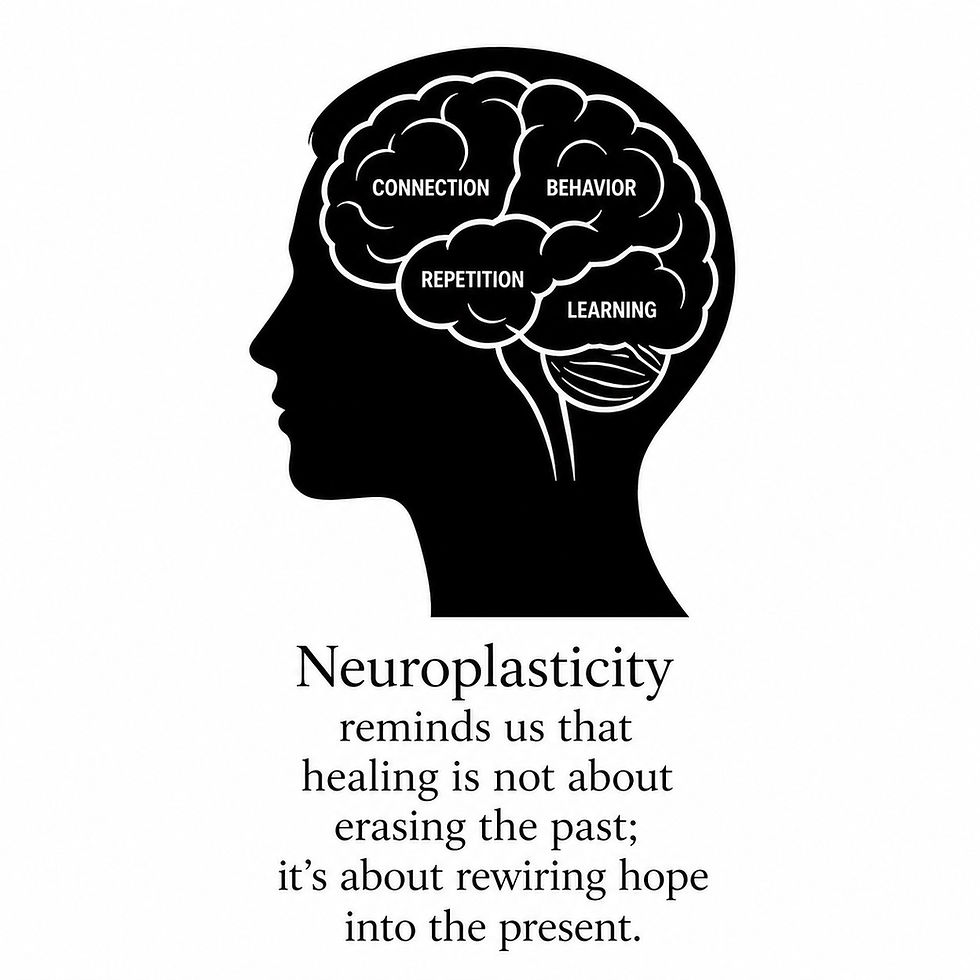
The brain has plasticity, meaning it has the ability to change, adapt and rewire over time.
In many ways, the brain is like a computer: what we repeatedly input can shape what we later output.
Repeated thoughts can become automatic patterns.
Repeated behaviors can become habits.
Repeated fears can become loops.
Repeated safe exposure can slowly weaken fear.
Repeated grounding can strengthen regulation.
Repeated action can build confidence and capacity.
Neuroplasticity reminds us that change is possible. With support, practice and repetition, the brain can learn new pathways.
When the brain doesn’t receive new input, it tends to repeat what it already knows.
When someone stays in:
the same space
the same routine
the same thoughts
the same fears
the same avoidance
the same shutdown
…the brain can fall into patterns.
It may start to replay:
past experiences
anxious predictions
automatic thoughts
old memories
familiar emotional pain
Not because something is wrong, but because the brain is trying to stay efficient and safe using what it already recognizes.
Without new input, there’s nothing new for the brain to work with.
Even small changes can begin to shift this:
a different environment
a new movement
a different conversation
a small action
a new experience
These create new signals and over time, new pathways.
Trauma Doesn’t Break the Brain — It Trains It
After trauma or long‑term stress, the brain doesn’t malfunction.
It adapts. Fear, hypervigilance, panic, shutdown, numbness, dissociation, avoidance; these aren’t signs of weakness. They’re learned survival responses.
The brain learns:
what to be afraid of
what to avoid
when to shut down
when to stay alert
when to conserve energy
These patterns form through repetition.
The brain is doing what it’s designed to do: protect
The problem isn’t that the brain learned survival.
The problem is that it keeps using those patterns long after the danger has passed.
Why the Brain Gets Stuck
After trauma or prolonged overwhelm, life often becomes smaller.
Fewer places feel safe.
Fewer actions feel possible.
Fewer risks are taken.
The brain receives very little new information. And when the brain doesn’t receive new input, it repeats what it already knows.
This is why anxiety loops.
Why trauma replays.
Why people feel stuck even when they understand what’s happening.
Insight alone doesn’t change the brain. Experience does.
The Pattern Loop - What Keeps People Stuck
Most patterns follow a loop:
Trigger → Thought/Feeling → Behavior → Outcome → Repeat
If nothing changes in this loop, the brain strengthens the same pathway.
This is why insight alone is often not enough.
How the Brain Actually Changes
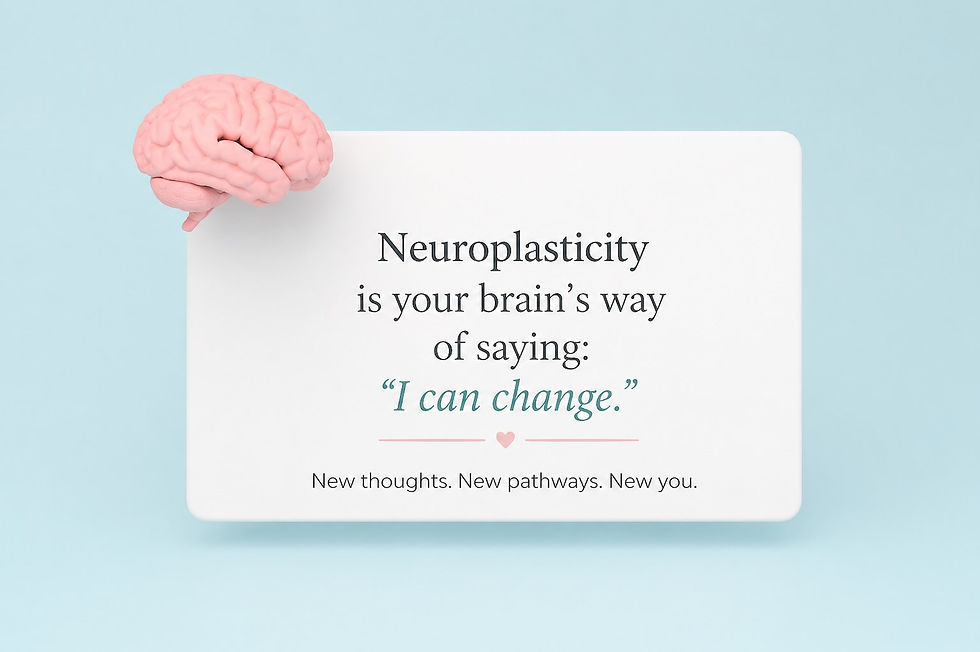
Change does not happen just by talking or understanding something.
The brain changes through:
Repetition
Experience
Action
Emotional and physical awareness
Every time:
respond differently
practice a new skill
pause instead of react
take one small step forward
you are rewiring your brain
then:
Repeated thoughts become automatic
Repeated behaviors become habits
Repeated fear strengthens fear
Repeated safety builds regulation
Repeated action builds capacity
This is why healing feels slow. The brain doesn’t change in one moment. It changes in layers, over time. Each small action gives the nervous system new data: “I survived this.” “This didn’t destroy me.” “I can handle more than before.” That’s neuroplasticity in real life.
Desire Isn’t Enough — Capacity Matters
Many people want to change. Wanting isn’t the issue. Capacity is.
Trauma, depression, anxiety, burnout and long‑term stress reduce capacity. The nervous system becomes overloaded. Even simple tasks can feel impossible. This isn’t laziness. It's a system running beyond its limits. Change happens when desire and capacity overlap; sometimes only briefly and the brain receives just enough new input to begin learning something different. Those moments matter more than people realize.
Rebuilding the Brain Is Not Dramatic
Healing doesn’t usually feel like a breakthrough.
It looks like:
small routines
gentle movement
grounding instead of avoidance
tolerating discomfort a little longer than before
adding structure
reducing chaos
creating safety
connecting with others
repeating things that don’t feel “impressive”
Over time, repetition teaches the brain that the present is safer than the past.
A Whole-Person Approach
Real change often requires more than talking.
It involves:
behavior (what we do)
thoughts and emotions (what we experience internally)
the body (how the nervous system responds)
the environment (where change takes place)
When these work together, change becomes more possible and more sustainable.
Why Change Feels So Difficult
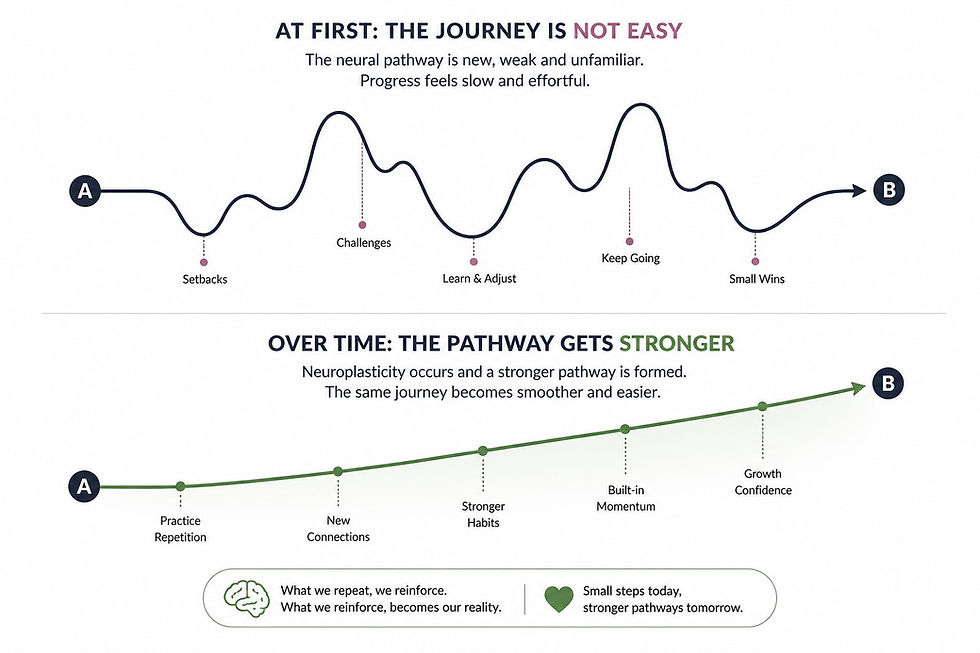
Change is hard because the brain prefers what is familiar even when it is not helpful.
Real change requires:
new experiences
new behaviors
new responses
Not once but repeatedly.
You don’t create change by “trying harder.” You create change by doing something different, consistently.
Why Coaching or Therapy Sometimes Doesn’t Work
Sometimes people spend months or years talking about their experiences, but still feel stuck.
This can happen when:
there is no active skill-building
learning stays at the level of discussion
changes are not practiced in real life
the body and nervous system is not included in the process
there is insight, but no structured action
The brain does not change through awareness alone. It changes through doing.
The brain changes through lived experience.
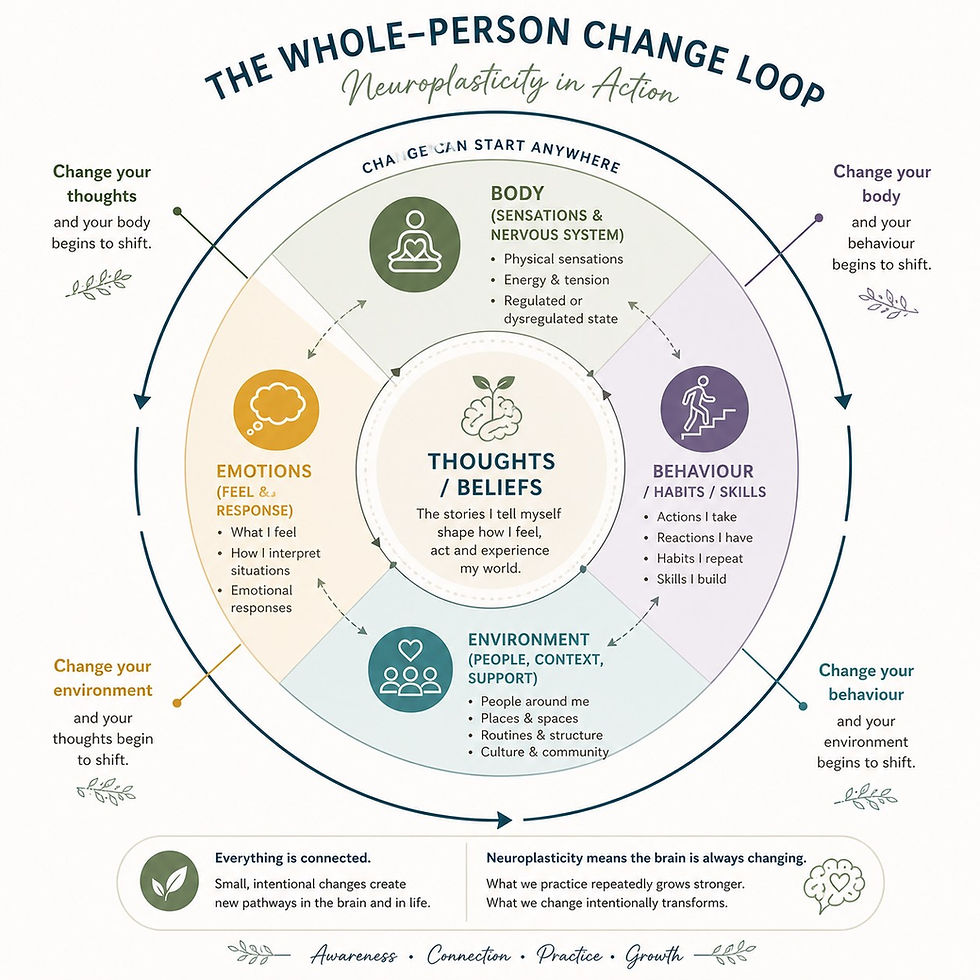
A Different Approach to Change
In my work, I focus on a whole-person approach:
Behavior (what you do)
Thoughts and emotions (what you feel)
Body (what you experience physically)
Environment (where change happens)
Because real change happens when:
you practice new patterns in real life; not just talk about them
This might look like:
practicing a small behavior step
learning how to regulate your body
noticing patterns in daily situations
building skills gradually and consistently
Small Steps Create Real Change
One of the biggest misconceptions is that change needs to be big.
In reality:
a 5-minute action matters
one different response matters
one moment of awareness matters
These small steps: begin to create new pathways in the brain

How to Start Rebuilding Yourself
You don’t need to change your whole life at once. You begin with small, human steps.
Grounding — reconnect with your body
Movement — walk, stretch, breathe
Routine — give your brain structure
Reduce overstimulation — less noise, less scrolling, less chaos
Face small fears — gently, gradually
Connection — talk to someone, even briefly
Identity — explore who you are without comparison
Rest — real rest, not distraction
These are some of nervous system tools.
They help your brain feel safer. They support regulation. They create space for change.
And over time, they rebuild the brain from the inside out.
The brain is not broken. It is adaptive.
It repeats what it knows until it is given something new.
With the right support, structure and small consistent steps, change is not only possible; it is natural.
This space is here to support your growth with practical tools, compassionate guidance and a steady path forward.
A place to pause.
A place to reset.
A place to begin again.
A Gentle
Reminder
You are not stuck. Your brain is doing exactly what it learned to do.
And with the right support, structure and repetition; it can learn something new.
Ready to Start?
If you’re feeling stuck and not sure where to begin:
You don’t need to figure everything out on your own.
Book a free consultation
We can explore your patterns together and take the first step toward change.
Comments